Partnerships · August 2026
Aminova × Corepay
More payment flexibility for modern clinics.
Clinics that prescribe need payment rails underwritten for prescription commerce. Our partnership with Corepay is designed to give them exactly that — without changing who holds the money.
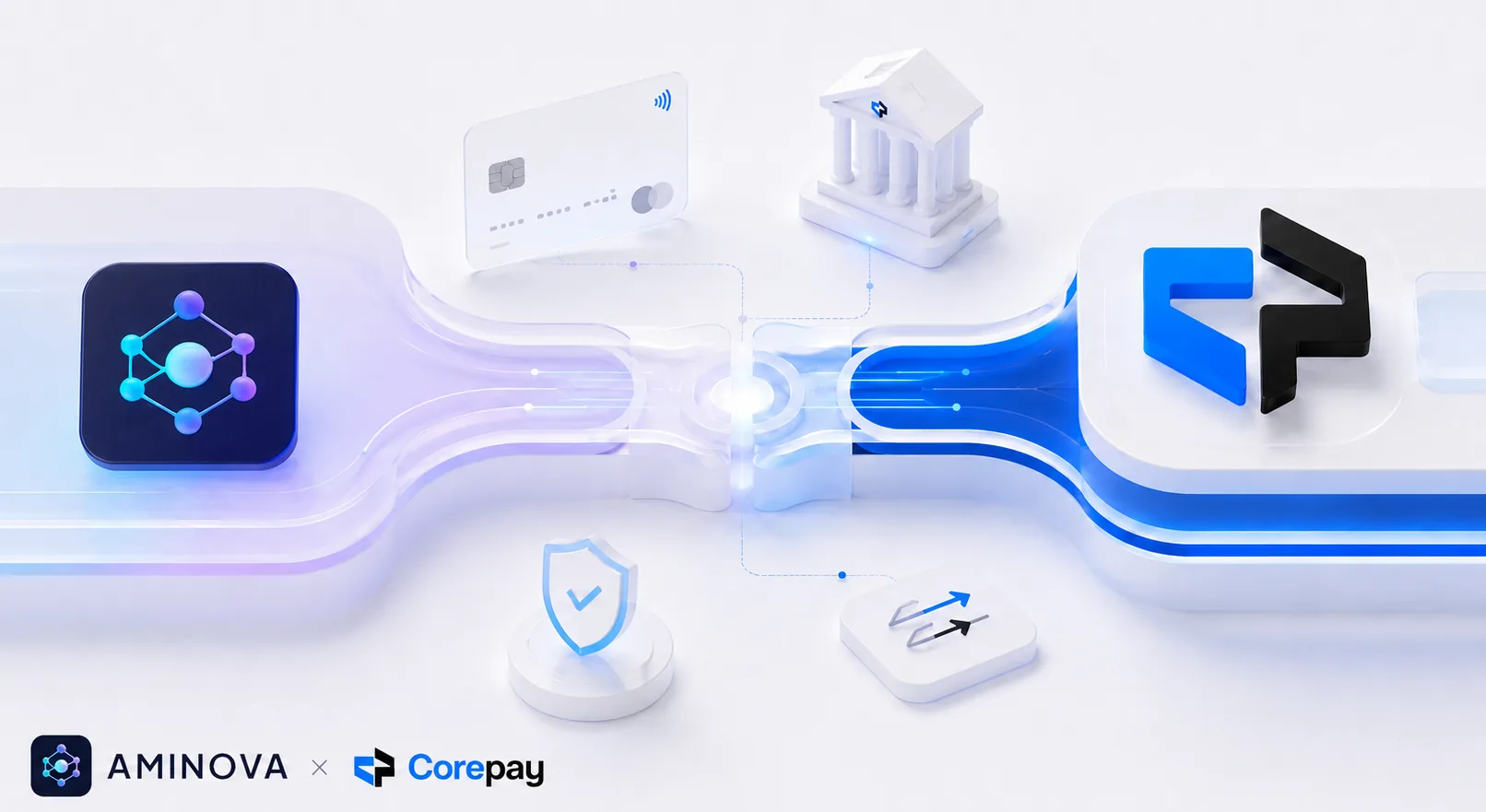
Aminova is partnering with Corepay, a payment processor that specializes in the categories of healthcare commerce mainstream processors were never built to underwrite. For clinics whose care model includes prescriptions — GLP-1 programs, hormone therapy, telehealth treatment plans — this is designed to close one of the most persistent gaps in running the business: payment processing that actually matches the medicine.
The problem nobody warns clinics about
Most payment processing is built for ordinary retail. Sign up in minutes, start charging cards, and the processor manages risk in aggregate across millions of generic transactions. That model works well for coffee shops and software subscriptions. It was not designed for a medical practice that sells prescription therapies.
Card networks and acquiring banks classify prescription commerce differently. It requires specific underwriting — verification that the practice is licensed, that prescribing is legitimate, that fulfillment is real. Mainstream aggregators generally don't do that underwriting, so a clinic running prescription charges through a standard retail account is operating outside its processor's terms, whether it knows it or not.
The consequences arrive at the worst time. Practices in this space have lost processing access mid-operation — accounts reviewed, restricted, sometimes with funds held — for reasons unrelated to the quality of care they deliver. None of this is malice: mainstream processors are enforcing risk models built for a different kind of business. But if part of your revenue is prescriptions, it is a structural exposure, and it deserves a structural answer.
The answer is not to disguise the charges. It's to process them on rails underwritten for exactly what they are.
What this partnership is — and what it isn't
Corepay specializes in processing for businesses that need real underwriting, including healthcare practices that sell prescription therapies. The partnership is simple, and deliberately so:
- Clinics hold their own merchant account. Eligible clinics can discuss an account with Corepay directly; the merchant relationship is between the clinic and Corepay.
- Clinic funds never flow through Aminova. We are not a payment facilitator and don't want to be. Your revenue settles to you.
- Aminova stays the software layer. The partnership allows us to build toward a cleaner path between Aminova's billing workflows and the clinic's own Corepay merchant account — invoicing, checkout, and reporting that understand which rail a charge belongs on.
This mirrors how we treat every integration on the platform. Your processor is yours. Your prescribing credentials are yours. Aminova connects them; it doesn't own them.
Split billing: the right rail for every charge
Aminova's billing model has never assumed one processor. Money moves five ways on the platform — card, in-person terminal, HSA/FSA, ACH, and cash — and the platform routes each charge to the rail that fits it. Wellness retail, visits, IV therapy, and memberships run on the clinic's standard processor. Prescription-related charges route to prescription-safe rails.
Consider a fictional example. A patient at Ridgeline Vitality checks out once: a follow-up visit, a vitamin infusion, and a prescription refill. Behind that single checkout, the platform splits the charge — the visit and the infusion settle on the clinic's standard processor, and the refill settles on the prescription-safe rail. The patient pays once. Each charge lands where it's underwritten to land. And statement descriptors are designed to carry the clinic's name — never a medication name.
The philosophy underneath: software should adapt to how a clinic legitimately operates. A hormone practice or a GLP-1 program is a real business practicing real medicine under real licenses. It shouldn't have to contort its billing to fit a risk model built for retail — and with the right rails in place, it doesn't have to.
Talk to us about payments
If you run a prescribing-led practice — or you're building one — payments are worth getting right before they become urgent. Eligible clinics can discuss a Corepay merchant account as part of onboarding, and our team will walk through how split billing applies to your actual service menu. Tell us what you sell and how you sell it, and we'll tell you plainly which rails fit.
Talk to our team about payments
Tell us what you sell and how you sell it — we’ll tell you plainly which rails fit.